


Stainless Steel Press Plates for Pressed SPC Flooring
 Oct 22, 2026|
 View:1
Stone Plastic Composite (SPC) flooring has become one of the fastest-growing categories in the global flooring industry. It is waterproof, dimensionally stable, rigid underfoot, and cost-effective for both residential and commercial projects. But from the consumer’s point of view, SPC flooring is not bought because of its calcium carbonate and PVC core—it is bought because the surface looks like wood, stone, concrete, or woven fabric. That realistic look and touch does not come from the decor paper alone. It comes from the stainless steel press plate mounted in the hot press or short-cycle lamination line.
Changzhou Senlong Press Plates Co., Ltd., established in 2002 in Henglin Town—“The Hometown of Laminated Flooring” in China—has spent more than two decades developing stainless steel press plates for laminate flooring, HPL, MDF, furniture panels, door skins, and increasingly demanding rigid flooring applications such as SPC.
This article explains what a stainless steel press plate for pressed SPC flooring is, why it matters, how it is made, and why manufacturers should treat it as a strategic production tool rather than a consumable spare part.
1. What Is a Stainless Steel Press Plate for Pressed SPC Flooring?
A stainless steel press plate is a precision-engineered steel sheet placed between the hot press platen and the SPC flooring stack. During pressing, heat and pressure are transferred through the plate into the wear layer, decor film, and SPC core. The micro-texture on the plate surface is “imprinted” onto the flooring surface, creating embossing, gloss control, anti-slip feel, and synchronized wood-grain effects.
For SPC flooring, the plate usually needs to deliver:
Uniform pressure across the full board format
Stable heat transfer for consistent melting and bonding
Precise texture depth for embossed-in-register (EIR) or non-synchro effects
Hard, corrosion-resistant surface for long production runs
Dimensional stability under thermal cycling
Easy demolding without sticking or plate marks
In short, the press plate is the “negative mold” that decides whether an SPC board feels cheap or premium.
2. Why SPC Flooring Puts Special Demands on Press Plates
SPC is different from traditional laminate. Laminate uses HDF and melamine-impregnated papers under high pressure. SPC uses a rigid vinyl-based composite core with a printed decor layer and a transparent wear layer, often fused in a short-cycle press or lamination process.
That changes the requirements for the press plate:
A. Higher surface fidelity
Modern SPC buyers want registered embossing. The texture must follow the printed grain—knots, sawn marks, stone veins, wire brush, hand-scrape, fabric weave. If the plate texture is inaccurate, the product looks fake even if the print is good.
B. Stable gloss and matte zones
Premium SPC often combines matte backgrounds with slightly raised glossy grain highlights. The plate controls this through micro-geometry, surface roughness, and chrome hardness.
C. Anti-stick and clean release
SPC wear layers can be sensitive to temperature and pressure. A poorly prepared plate causes film tearing, plate lines, orange peel, or stuck wear layer.
D. Long run economy
SPC factories run large volumes. A plate that loses definition after a few thousand cycles raises rejection rates. Hard chrome plating and precise base-material selection directly affect cost per square meter.
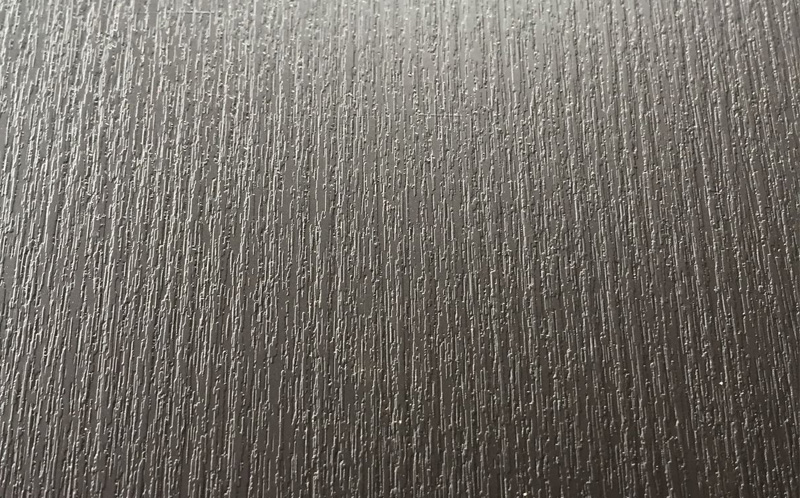
3. Senlong’s Approach: Imported Base Steel + CNC/Etching + Hard Chrome
Senlong uses imported original-pack stainless steel as the base board and processes it with advanced equipment. For SPC-related plates, the typical route is:
Step 1: Base plate selection
Common grades include 304 stainless steel and upgraded alloys such as 633 stainless steel, chosen for hardness, thermal stability, and resistance to deformation. Thickness is usually 3 mm, 4 mm, 5 mm, or 6 mm, depending on press size and pressure profile.
Step 2: Texture creation
Two main technologies are used:
CNC engraving / embossing: deeper, stronger 3D structures such as deep wood grain, stone rift, geometric design, leather, fabric, and door-skin patterns.
Chemical etching: finer lines, subtle gradients, detailed graphics, and cost-effective reproduction of complex decor-paper patterns.
For SPC flooring, many customers use etched + lightly CNC-structured plates to balance realism and cycle life.
Step 3: Hard chrome plating
After texturing, the plate receives hard chrome plating—commonly around 0.05 mm or 10–25 µm depending on specification. This improves:
surface hardness
abrasion resistance
corrosion resistance
demolding performance
service life under high temperature and pressure
Step 4: Grinding, polishing, inspection
Flatness, gloss uniformity, texture depth, and edge quality are checked before shipment. For SPC, flatness is critical: any wave or local high spot becomes a visible press mark on every board.
4. Surface Effects Senlong Can Supply for SPC Flooring
Senlong’s product system covers a wide decorative range, suitable for SPC surface lamination:
Wood grain: oak, walnut, ash, maple, teak, smoked wood
Zero-degree wood texture: very fine, low-gloss, natural touch
Deep emboss: pronounced 3D timber or stone structure
Synchro / EIR: texture aligned with printed decor
Non-synchro texture: independent tactile surface
Stone and concrete: marble, slate, terrazzo, industrial concrete
Fabric and linen: for designer wall-panel-type SPC
Leather finish: soft-touch premium panels
Geometric and architectural patterns
Matt, satin, semi-gloss, and structured gloss combinations
Because SPC is often used in kitchens, bathrooms, retail, and hospitality, anti-slip and easy-clean textures are also in demand. The plate design can be tuned for slip performance without making the floor uncomfortable.
5. Standard Sizes and Customization
Senlong supplies common flooring formats such as:
4’ × 8’ — 1250 × 2460 mm
4’ × 9’ — 1250 × 2750 mm
5’ × 8’ — 1530 × 2460 mm
5’ × 9’ — 1530 × 2750 mm
Width up to 2400 mm and length up to 5500 mm can be discussed for special lamination lines. Thickness, texture depth, chrome thickness, gloss target, and registration marks can all be customized.
A good SPC press-plate project usually starts from three inputs:
The decor paper or digital print file
The press machine model and platen size
The target market: budget residential, premium residential, commercial, or project flooring
From there, Senlong can develop a matching plate so the printed image and tactile surface tell the same story.
6. How the Plate Affects SPC Quality Indicators
Many SPC quality problems are blamed on the wear film or decor paper, but the press plate is often the root cause.
Problem on SPC board | Possible plate issue |
|---|---|
Uneven gloss | Inconsistent chrome layer or surface roughness |
Visible press lines | Poor flatness, edge damage, platen contamination |
Weak emboss definition | Shallow etching, worn texture, low chrome hardness |
Misaligned texture vs print | Wrong EIR registration, plate not matched to decor |
Sticking / film tear | Bad demolding, insufficient chrome quality |
Short plate life | Soft base steel, thin chrome, aggressive pressure |
Orange peel / waves | Thermal deformation, uneven pressure transfer |
This is why Senlong treats press plates as engineering components, not just steel sheets.
7. Why Global SPC Buyers Care About the Plate Indirectly
A flooring brand may never see the press plate, but it experiences the result:
Does the sample photograph well?
Does the display floor feel real?
Does the texture match the print under raking light?
Does the product survive abrasion and cleaning?
Can the factory repeat the same surface six months later?
A well-made stainless steel press plate gives SPC manufacturers repeatability. That repeatability is what allows export customers, distributors, and project specifiers to trust a collection season after season.
Senlong’s plates have been widely used in Southeast Asian and South Asian markets, and the company’s history in laminate flooring press tooling gives it strong know-how for transferring laminate-grade surface realism into the SPC category.
8. SPC Press Plate vs Laminate Press Plate: Key Difference
While the technologies overlap, SPC plates often need:
Better thermal stability at vinyl lamination temperatures
Smoother release for wear-layer films
Finer control of matte/gloss micro-structure
Compatibility with registered embossing systems
Less aggressive depth than heavy HPL or door-skin embossing
Laminate plates can be deeper and more aggressive. SPC plates must be precise, clean, and consistent because the visual layer is thinner and the surface is more sensitive.
9. Maintenance Tips for SPC Press Plates
To maximize plate life:
Keep platens clean before every shift.
Avoid abrasive cleaning pads that destroy micro-texture.
Use correct release/maintenance products recommended for chrome plates.
Store plates flat, not leaning or stacked with hard objects.
Track cycle count and inspect texture depth periodically.
Send worn plates back for re-chrome or reconditioning when definition drops.
Senlong also supports customer-specific development and after-sales service, which is important for factories running multiple SPC decors.
10. Conclusion: The Press Plate Is the Surface Brand of Your SPC Flooring
SPC flooring competes on appearance, touch, and consistency. The printed film gives the picture. The wear layer gives protection. But the stainless steel press plate gives the soul: the grain you feel, the light you see, the realism that convinces the customer.
Changzhou Senlong Press Plates Co., Ltd. combines imported stainless steel base material, CNC embossing, chemical etching, and hard chrome technology to help SPC manufacturers upgrade from “flat printed vinyl” to “premium rigid flooring with real texture.” Whether the target is oak sync wood, matte stone, linen texture, or deep embossed designer panels, the right press plate is the difference between a commodity product and a brand-grade surface.
For SPC flooring factories, the smart move is not to buy the cheapest plate. The smart move is to choose a press-plate partner who understands decor paper, lamination pressure, texture depth, chrome life, and market trends.


View More(Total0)Comment lists